How Credit Scores Impact Your Ability to Secure Fast Cash
EB
Elena Brooks
Certified Financial Planner (CFP®) · Updated July 2026
Elena Brooks
Certified Financial Planner (CFP®) · Updated July 2026
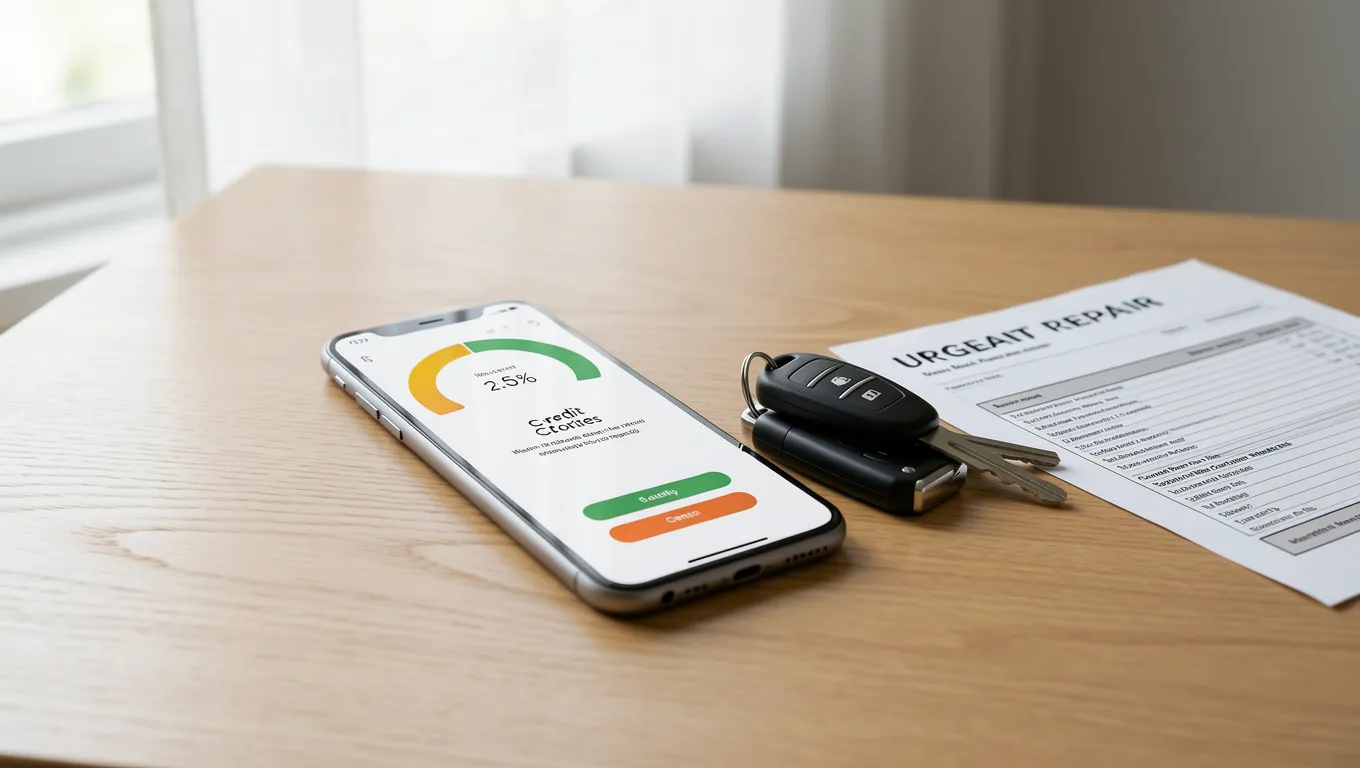
Imagine it is a Tuesday evening in mid-2026. You are faced with an unexpected $2,500 transmission failure that leaves your car—your primary way of getting to work—completely sidelined. In this moment of urgency, you need liquidity immediately. However, as you browse digital lending options, you realize that the speed at which you can access funds is inextricably linked to a three-digit number: your credit score. Many borrowers believe that if they have a job and an income, the money should be accessible regardless of their history, but the reality in 2026 is far more nuanced.
The connection between your credit profile and loan accessibility isn't just about whether you get approved; it is about the cost of that speed. In the current financial landscape, a borrower with an Experian score of 740 may find themselves looking at APRs as low as 8%, whereas someone with a score in the 580 range could see offers exceeding 32%. This discrepancy can mean the difference between a manageable monthly payment and a debt spiral. Furthermore, while some fintech lenders offer near-instant decisions, those same lenders often use automated algorithms that weigh your credit history heavily to mitigate risk.
This article is designed to pull back the curtain on how these scoring models function in the modern lending ecosystem. We will explore why certain lenders prioritize speed over deep scrutiny and how you can navigate the complexities of various credit tiers. By the end, you should have a clearer understanding of whether your current score allows for high-speed funding or if you need to pivot toward different financial strategies. Please note that terms and availability depend entirely on individual lender criteria.
As we dive into the mechanics of lending, it is important to recognize that while platforms like CashSwift can help connect you with various options, no single entity can guarantee an approval. The goal here is to equip you with the knowledge to make informed decisions when time is of the essence.
To understand why your score matters, you have to look at how lenders price risk. In 2026, the mathematical relationship between credit tiers and interest rates remains the cornerstone of personal finance. Lenders use a tiered system where each jump in your score could result in a significant reduction in your Annual Percentage Rate (APR). This isn't arbitrary; it is a calculated response to the statistical probability of default within specific scoring brackets.
Consider these typical scenarios for a $5,000 personal loan over a 36-month term:
While a $55 difference per month might not seem catastrophic at first glance, over the life of the loan, you are paying hundreds—sometimes thousands—of dollars extra simply for having a lower score. This is why credit health is often described as 'expensive debt'.

In the digital-first economy of 2026, speed is a commodity. When you seek 'fast cash', you are essentially asking a lender to perform an accelerated risk assessment. For many automated lenders, this means they rely heavily on traditional credit scores because those numbers provide a rapid snapshot of your reliability. If your score is in the 'prime' category (typically 670 and above), the algorithm can process your data and issue a decision in seconds.
However, if your score is lower, the lender faces a dilemma: do they spend more time manually reviewing your bank statements to verify income, or do they simply decline the application to save on operational costs? Most high-speed fintech lenders choose the latter. This creates a paradox where the people who need cash most urgently—those with lower scores—often find it the hardest to access through rapid-approval channels.
This is why understanding your score before you apply is vital. If you are in a rush, knowing that your score might fall below a lender's threshold can prevent you from wasting time on an application that is unlikely to yield the speed you require. Always check if a lender performs a 'soft pull' for initial quotes, as this does not impact your score.
A common misconception is that your FICO or VantageScore is the only thing a lender looks at. While it is the primary driver, modern lenders in 2026 have become increasingly sophisticated, looking at 'alternative data' to fill the gaps left by traditional scores. This includes your Debt-to-Income (DTI) ratio and your recent payment history.
Even with a stellar credit score of 800, you may be denied fast cash if your DTI is too high. For example, if you earn $5,000 a month but your existing debt obligations (rent, car loans, student loans) already consume $2,500, your DTI is 50%. Many lenders view this as a red flag for new, rapid-access debt. They want to see that you have 'breathing room' in your monthly budget.
Other factors include:
When deciding how to secure funds, you will likely face a choice between two primary paths: the traditional banking route or the modern fintech/rapid-approval route. Each has distinct trade-offs that depend heavily on your credit profile.
Option A: The Traditional Bank Loan
Banks typically offer much lower interest rates and more flexible repayment terms. However, the 'cost' of these benefits is time. Even in 2026, a traditional bank may require several days or even a week to verify your documentation and move through their internal approval hierarchy. This is not an ideal solution if you are facing an immediate emergency.
Option B: Rapid-Approval Fintech Loans
These lenders specialize in speed, often providing funds within hours. The trade-off for this convenience is almost always a higher APR or stricter automated requirements. If your credit score is excellent, fintechs can be a powerful tool; if it is low, they may become prohibitively expensive.
The decision framework is simple: Is the cost of the interest worth the time saved? For a $1,000 emergency repair, paying an extra $50 in interest to get the money today might make sense. For a $10,000 home improvement loan, waiting ten days for a bank's lower rate is almost always the smarter financial move.
If you find yourself in a position where your credit score isn't quite where you want it to be, but you need cash quickly, follow this step-by-step framework to maximize your chances of success:
By following this sequence, you move from reactive panic to proactive management. You avoid the common pitfall of applying for multiple loans simultaneously, which can create a 'hard inquiry' surge that further depresses your score.
In the rush to secure fast cash, many borrowers fall into the trap of 'predatory lending'—offers that seem easy to obtain but carry astronomical interest rates. In 2026, these often manifest as payday loans or high-interest installment loans with terms that are difficult to understand at first glance.
Warning: Always read the fine print for 'prepayment penalties'. Some lenders charge you a fee if you try to pay your loan off early. This is a way of locking you into their high interest rates even after your financial situation has stabilized. If a lender makes it difficult to see the total cost of credit upfront, walk away.
A common mistake is assuming that an 'instant approval' means an 'instant low rate'. Many lenders use a two-step process: they approve you quickly based on your score, but once they pull your full report, the interest rate shifts significantly higher. Always ask for the maximum possible APR before you sign any digital agreement.